When Small Spaces Ask for Better Design

Welcome to the Nomadic Calm.
When I first walked into this apartment, it was completely empty.
Same floors. Same paint. No curtains, no lighting, no furniture. Just height, tight proportions, and the quiet pressure of a deadline. It was one of the smallest spaces I’ve worked with in a long time, and it required a different kind of attention.
Not more effort, more restraint.
The brief was to create a home for a US-based client when she’s in South Africa, and a space that functions effortlessly as an Airbnb when she’s not. What the space itself was asking for, however, was clarity.

Small Spaces Don’t Need More, They Need Precision
In compact homes, design decisions carry more weight.
There’s no room for filler, no space to hide a mistake, no forgiveness for furniture that doesn’t quite belong. Every piece has to earn its place.
For The Nomadic Calm, we chose visual lightness over volume. Glass tables, open-legged chairs, soft silhouettes. We allowed negative space to exist, understanding that emptiness is often what makes a room feel calm rather than unfinished.
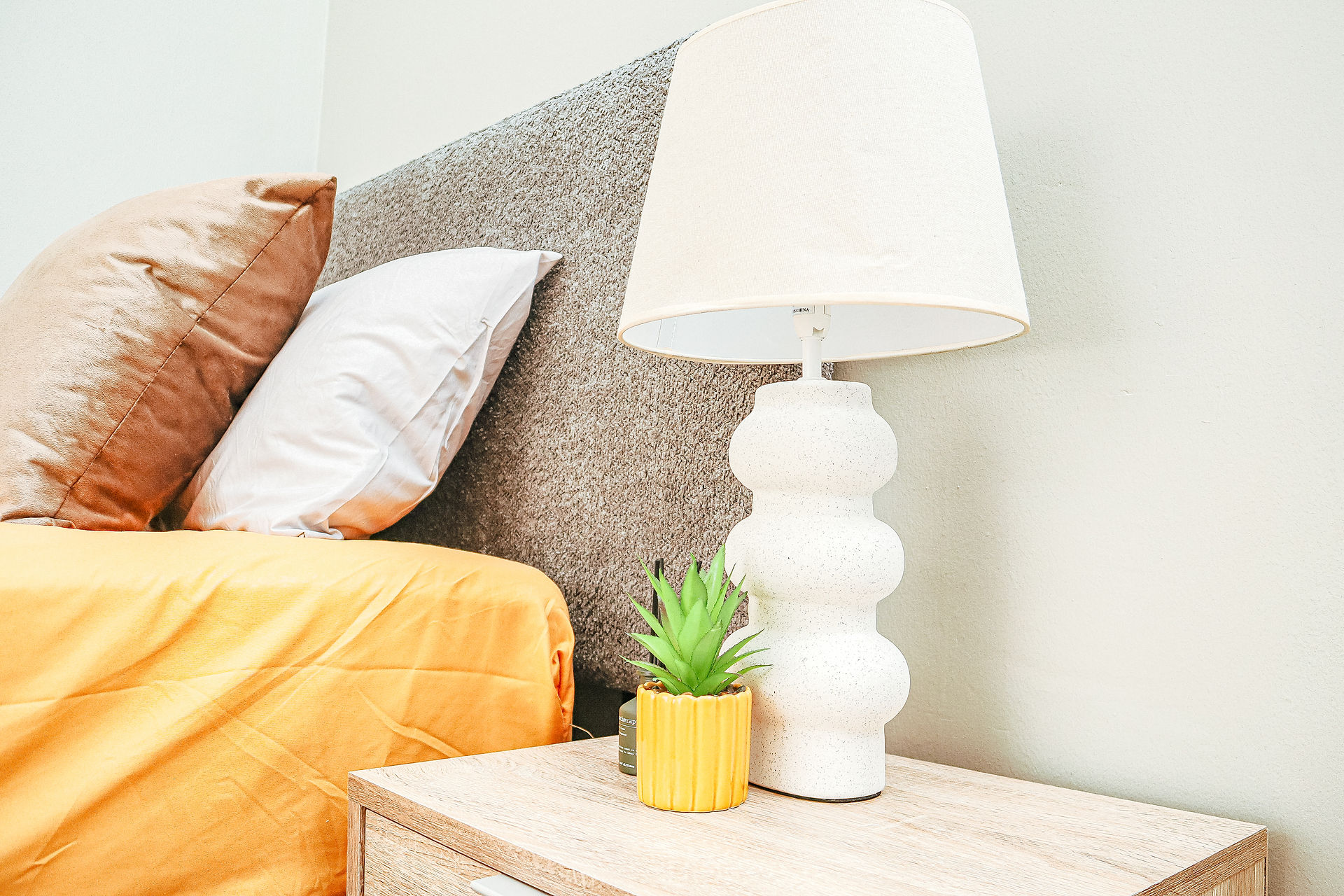
In both bedrooms, there was only space for one bedside table. Instead of forcing symmetry, we embraced asymmetry. The rooms feel intentional, not compromised, because they are honest about what they can hold.


Colour as a Language of Calm
The palette became the quiet thread that held everything together.
Soft greys, clay-inspired rusts, muted greens, warm woods, and charcoal accents were layered gently throughout the apartment. These colours don’t demand attention. They ground you.
In a small space, colour continuity is essential. When tones move seamlessly from room to room, the apartment feels larger, slower, and more resolved. This palette allowed the space to feel lived in without feeling busy.
Editing the Space to Let It Breathe
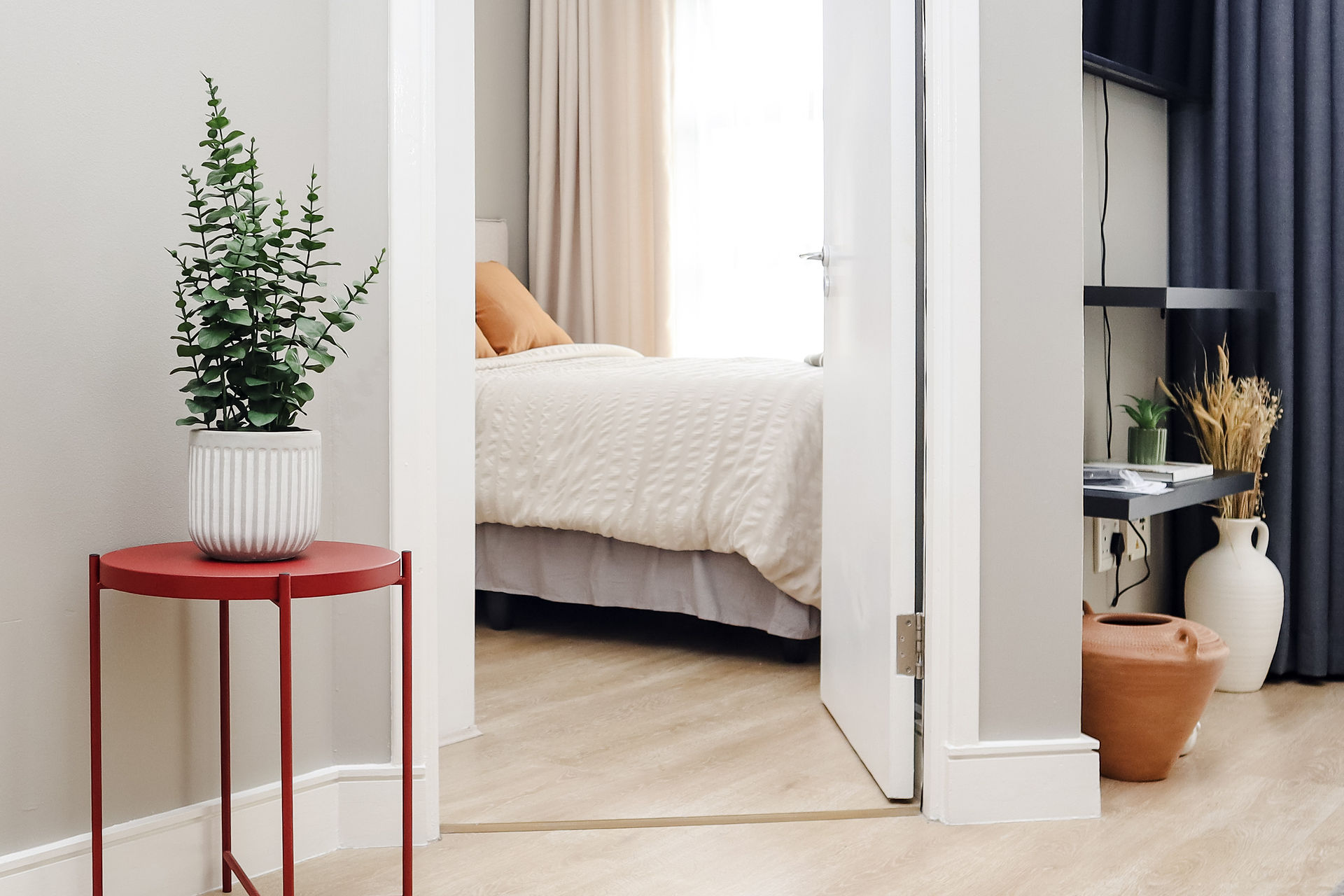
One of the most defining moments in this project was the decision to remove a cupboard door and convert it into open shelving.
That single edit changed the rhythm of the room. What was once visually closed became open, layered, and alive. Greenery, ceramics, and everyday objects could now exist without adding visual weight.
We leaned into the apartment’s height deliberately. Full-length curtains were newly fitted to honour the ceilings, and a sculptural light shade was introduced to soften the vertical volume. These gestures drew the eye upward, counterbalancing the compact footprint below.

Designing Without a Safety Net
This project also came with an unusual constraint for me.
Due to timing, there was no opportunity for formal space planning. I worked from memory, experience, and instinct. That meant every decision had to be adaptable. Nothing could be too rigid to change.
Some choices landed immediately. Others required adjustment.
A floating TV unit that made sense conceptually proved too heavy once installed and was returned. The television itself had to be downsized to suit the scale of the room. These moments weren’t failures, they were acts of discernment.
Even seasoned designers benefit from precise measurements. This project reinforced why space planning matters, and why humility is part of good design.


From Empty Apartment to Sanctuary
Aside from the paint and floors, everything you see here was introduced with intention.
The furniture. The curtains. The lighting. The textures. Each layer was chosen to support calm, flow, and function. The process was quiet, but the result feels deeply considered.
Most guests will never know how many decisions were edited, adjusted, or rethought. And that’s the point.
Good design doesn’t announce its process. It simply holds you well when you arrive.
The Nomadic Calm is a reminder that small spaces don’t limit design, they refine it.
When we stop trying to make a space more than it is, and instead allow it to be exactly what it needs to be, something shifts. The home becomes lighter. Calmer. More honest.
Not because it has everything,but because it has enough.


Comments